
Printed scarves process
Every new design I start with sketches, exploring composition, movement and emotion. Drawing is my way of listening inward. Images that linger somewhere at the back of my mind surface, gradually take shape on paper and signal to me.
Each design develops as a complete artwork in its own right — not a digital pattern or an arrangement of separate elements.
1
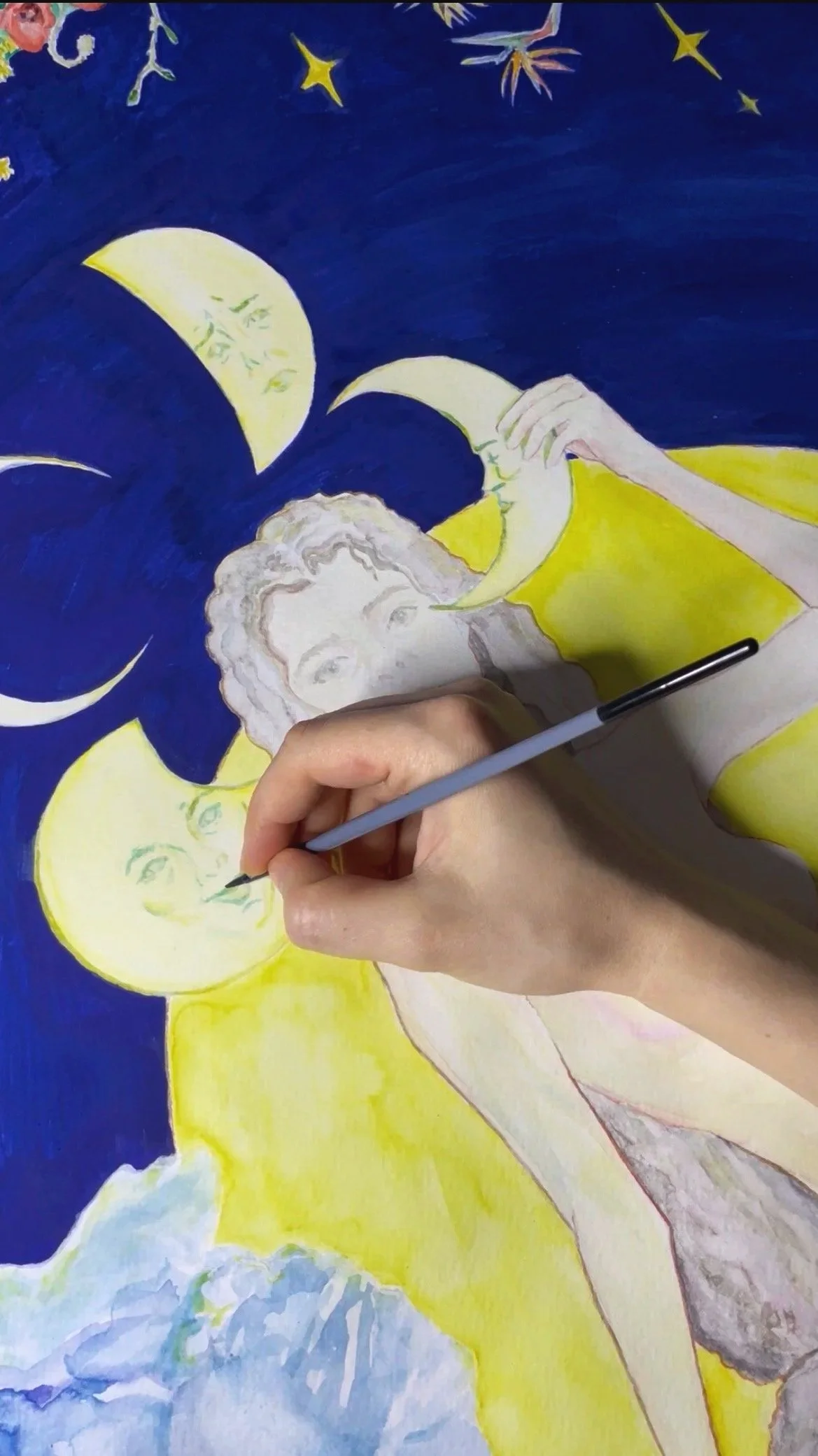
Next, I create a full-size painting using mixed media, primarily watercolour. I slowly build the image in transparent layers, letting the pigments flow, merge and deepen. This stage always draws me in completely. Watching colour move through water and paper feels miraculous.
Once complete, the painting is scanned in very high resolution to capture every brushstroke and subtle transition of colour. This step translates something fragile into a form that can travel further, while holding on to the character of the original work.
2
Afterwards, I prepare the scanned image for printing, ensuring that tones, contrasts and proportions faithfully translate. This stage is less about creating and more about preserving what already exists.
The design is then printed onto fine twill silk. This fabric has a soft, buttery feel and a gentle slip to it. This enhances the fluid quality of the watercolour painting. The colours do not sit flat on the surface; they sink into the material, becoming part of it. Light catches the weave differently as the fabric moves, giving the image depth and a sense of vitality.
For now, I choose not to produce double-sided prints. Despite a common assumption, silk is not literally printed “on both sides.” The inks are applied to the front, but they penetrate the fibres and become visible on the reverse to varying degrees, depending on the thickness of the silk and the amount of pigment used. Some techniques can make front and back appear almost identical, even on heavier fabrics.
Personally, I prefer the single-faced print. The reverse side is not blank or stark white. The image remains visible there, softer and more diffuse. To me, it feels like another state of the same artwork — not a copy, but an echo. Sometimes it looks like a beginning, sometimes like a fading, like a blossom or its afterimage. I find this duality harmonious and alive, more tactile and emotionally satisfying than perfect symmetry.
3
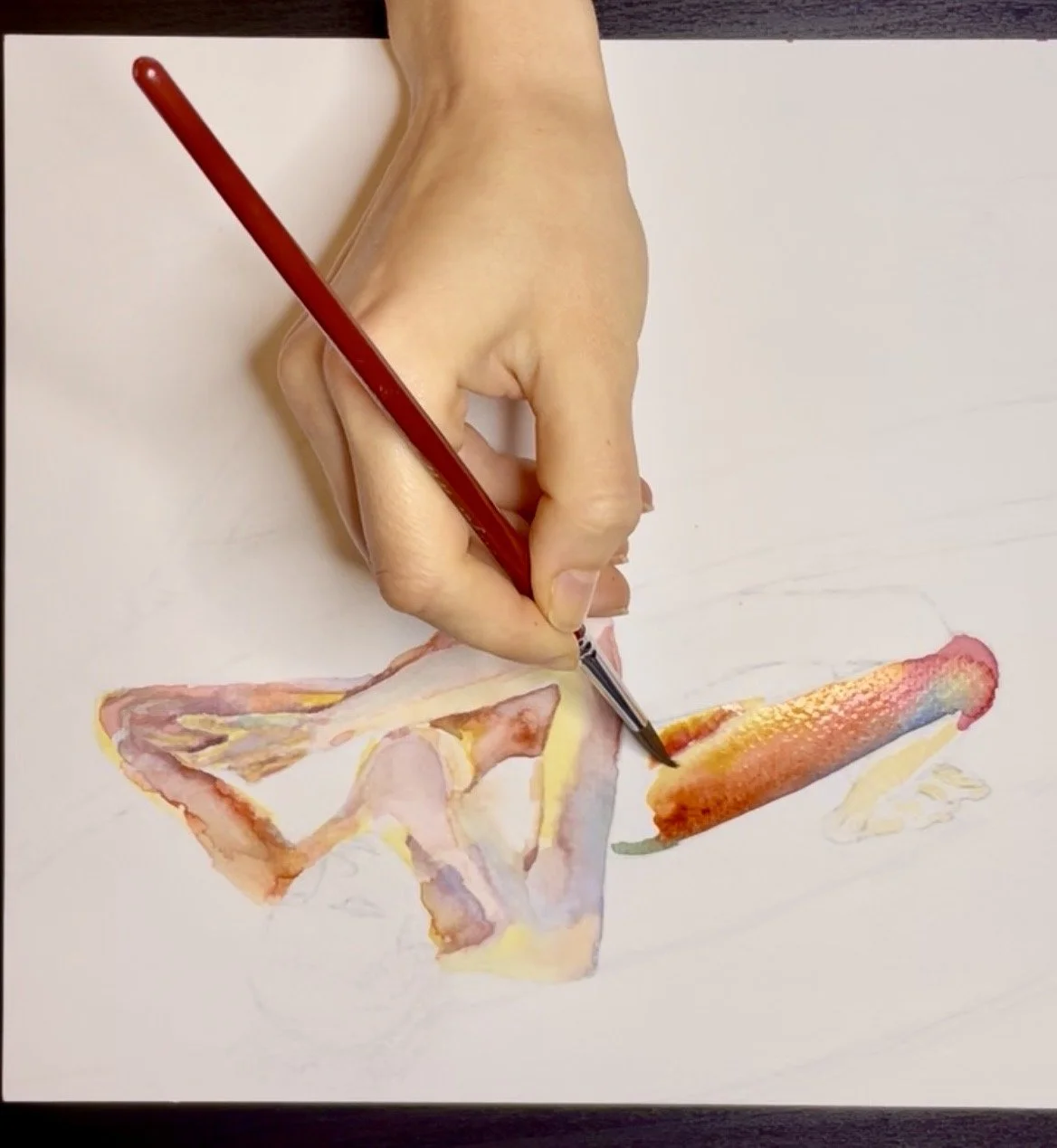
I can hardly wait for the scarves to arrive from Ukraine, where my wonderful manufacturers bring these works into their final form. Each printed piece is then carefully examined to ensure the colours, details and overall mood remain true to the original artwork.
I feel a personal connection to every design. A thought that comes from a gentle place and the wish to share. Friends often ask what a particular painting means, but I rarely have precise words. The images exist somewhere closer to a sensation.
Even as an edition, the scarf carries the memory of that first hand-painted moment. As a fragment of something once still, now able to move through the world and become part of someone’s daily life